Learning Zone - Research Techniques
Discover the lives of your ancestors
Search Scottish Prison Registers
Discover Sheriff Court Criminal Records
Discover Discover Mental Health Records
When there is no father's name! What can you do?
Discovering more than your ancestor's name, age and birthplace
Five Ways to Save ScotlandsPeople Credits
Discover the lives of your ancestors
What did romantic drama look like in 19th-century Scotland? How did ordinary people navigate love, work, scandal and responsibility? In this video, Emma Maxwell of Scottish Indexes will take you step by step through a remarkable Sheriff Court paternity case that reveals the real story behind one family's past and shows you how to uncover similar stories in your own research.
Using the case of Agnes Heatlie and Arthur Bell, we explore:
How to use the 1861 census to spot clues and ask the right questions
Why civil registration notes and the Register of Corrected Entries matter
How to search ScotlandsPeople effectively using wildcards
What Sheriff Court decrees and processes can tell you
How to follow up references and locate original records at the National Records of Scotland
How to use Ordnance Survey Name Books and historical maps to understand place names
How to build a timeline that reveals the truth behind the documents
Why searching for the 'unknown' can lead to unexpected discoveries
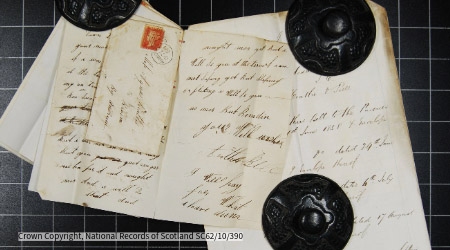
You will also see original 19th-century love letters preserved in the court papers, offering a rare and moving glimpse into the personal lives of our ancestors.
Whether you are new to Scottish genealogy or looking to deepen your research skills, this video will help you trace your ancestors with confidence, curiosity and historical insight.
Search Scottish Prison Registers
Unlock the stories hidden in Scotland's prison records. In this video, Emma Maxwell explores what you can learn from 19th and early 20th-century prison registers, how to interpret the details they contain, and where to find these valuable sources online.
Whether you are tracing an ancestor who spent time in custody or simply want to understand the justice system of the past, this guide will help you read the records with confidence.
If you are researching Scottish family history, this is an essential introduction to a rich and revealing set of documents.
Discover Sheriff Court Criminal Records
Sheriff Court documents can transform your family history research. They reveal details you will not find in statutory registers or parish records, and they often fill gaps where other sources are silent. In this video, Emma Maxwell of Scottish Indexes explains how to trace criminal cases in the Sheriff Courts and how these records can illuminate the lives of our ancestors.
You will learn:
What Sheriff Courts were and where they sit within Scotland's criminal justice system
The difference between solemn (jury) and summary trials
How criminal records are arranged in the National Records of Scotland
What survives, what is indexed, and how to navigate unindexed material
How to use prison registers, Crown Counsel Procedure Books, and newspapers as finding aids
Real examples showing how a case can be followed from index to original record
Whether you are researching a specific ancestor or exploring the wider social history of Scotland, Sheriff Court records offer remarkable insights. Visit the Scottish Indexes Learning Zone for further guidance and additional record types.
Discover Mental Health Records
Unlock the stories hidden in Scotland's mental health records and learn how these remarkable documents can transform your family history research.
In this video, Emma Maxwell from Scottish Indexes guides you through the General Register of Lunatics in Asylums and the detailed admission forms created from 1858 onwards. You will see what information these records contain, how to interpret the terminology of the time, and how to use our index to trace your ancestors through multiple admissions.
Emma explains:
What the General Register records and how to use patient numbers effectively
How admission forms were created and what biographical and medical details they include
Why language in historical records can feel uncomfortable today, and how to understand it in context
How to search the Scottish Indexes database and interpret your results
What to expect when ordering copies of records
Additional sources that may help you follow an ancestor’s story, including poor relief records and asylum archives
Whether you are just beginning your research or exploring a complex family story, these records offer extraordinary insights into the lives of people who were often overlooked.
Explore the index on our website and start discovering your own family's history.
Using the NRS reference
Here is a tip from genealogist Emma Maxwell to help you make the most of Scottish Indexes to trace your Scottish family tree.
When there is no father's name! What can you do?
It can be very frustrating when a Scottish birth certificate does not name the father. If the parents of a child were not married a father's name would only be recorded if he presented himself to sign the register when the birth was registered or a court action led to his name being added.
After 1855 it is important to remember that there are baptism registers. We do not use them in Scotland much because the post-1855 civil birth registers are so detailed, fully indexed and available online.
The church, however, was not bound by the same rules as the registrar when it came to recording parents' names. As you can see in this example, it is a baptism register which gives us the breakthrough we need.
Discovering more than your ancestor's name, age and birthplace
To research your family tree you need to start by talking to family members and looking at birth, marriage, death and census records. This will give you a basic tree but do you want to find out more?
In this video, genealogist Emma Maxwell shows one way to dig further into your family history. Emma shows how she uses newspapers, court indexes and original records to piece the family story together.
Using Wildcards
Finding ancestors is a challenge when there are spelling variants and transcription errors. Wildcards will help you find those elusive ancestors in seconds.
This tip works on our website but will also work on many family history websites.
Five Ways to Save ScotlandsPeople Credits
Only ScotlandsPeople gives online access to civil registration, Church of Scotland parish records and Scottish census record images. We all know how important it is to view these original documents to make sure our research is accurate but the costs can soon mount up if we keep viewing the wrong records. Here are five tips to help you pick the right record the first time.
1 - Post-1855 Death Records
Cross-reference death records using a woman's maiden surname. In Scotland deaths of married women are indexed under all the names she used during her lifetime (or at least all the names the person registering the death knew about). Let's say your ancestor was born Janet Porteous and she went on to marry a Thomson. There will be a lot of Janet Thomsons, so use the surname Porteous to narrow down your search. On the search page look out for 'Other surname'. It does not matter which way round you put the surnames, put Thomson in one and Porteous in the other and it will narrow down your search.
2 - Birth Records from 1855 to 1874
The International Genealogical Index (IGI) includes most Scottish civil registration births from 1855 to 1874. Unlike the index on ScotlandsPeople, the IGI includes the names of both parents. This enables you to narrow down your search then view only the correct entry on ScotlandsPeople. This index is available on Ancestry, Findmypast and FamilySearch.
3 - Census Records 1841 to 1901
Use an index to the 1841-1901 census you already have access to. FreeCen gives access to a free indexed transcription of many Scottish census records from 1841 to 1901 (it is particularly for the earlier years) and it is a great way to find the right household. Then you can simply go to ScotlandsPeople to view the original. You may also have access to the 1841-1901 census as part of your Findmypast or Ancestry subscription or you may have free access through your local library.
4 - 1911 and 1921 Censuses
As only ScotlandsPeople gives access to the 1911 and 1921 censuses for the whole of Scotland we need to be a bit more savvy. Use the reference to group family members together. Let's say I am looking for a 'Scott' family in the parish of Annan. I will see a lot of entries, for example there are four Agnes Scotts in the parish of Annan in 1911. In the free index on ScotlandsPeople I am also given the reference ('Ref'), which is key. I can see, for example, that there is an Agnes Scott aged 48 with the reference '812/ 5/ 10' and another Agnes Scott aged 49 with the reference '812/ 2/ 10'. Let's break the reference down, 812 is the parish number for Annan. 812/2 means enumeration book two in the parish of Annan and the 10 at the end is the page number. This means that I know these two Agnes Scotts are not in the same household. Looking through the other 'Scott' entries for Annan I see that there are the following entries with the reference: 812/ 2/ 10. I can see James Scott aged 51, Robert Scott aged 20 and George Scott aged 17. Now I have a family group, this should be enough to tell me I have the right family or, in fact, that it’s the wrong family and I don't need to waste my credits.
5 - Church of Scotland pre-1855 Births and Marriages
Although the images are not available, indexes to the Church of Scotland pre-1855 births and marriages found within the Old Parish Registers (OPRs) are available in various places. As with the 1855 to 1874 civil registration birth records, you can find indexes available on Ancestry, Findmypast and FamilySearch, entitled 'Scottish Church Records'. Again a feature is that you can search by parents' names. At first glance this feature is not available on ScotlandsPeople but it actually is! Enter your search criteria and click search in the usual way. When your results appear you will see new search options. You can now add '1st Parent Name' and '2nd Parent Name', which will enable you to narrow down your search. I like to search by the surname of the child and the full name of the parents, which shows all children born to that couple.